

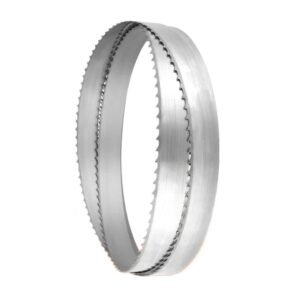
Quick answer: TPI means “teeth per inch.” Pick it wrong and you’ll snap teeth, burn wood, or watch the blade skate across the steel without cutting. The rule that solves 90% of blade-choice mistakes: keep at least 3 teeth in contact with the workpiece at all times — ideally 3 to 6. Thin material needs more teeth per inch; thick material needs fewer.
Whether you’re running a 14″ woodworking bandsaw, a portable Milwaukee, or a horizontal metal-cutting saw, this one rule tells you which TPI to buy.
What TPI Actually Means
TPI counts how many teeth fit into one inch of blade. A 6 TPI blade has six large, widely-spaced teeth; an 18 TPI blade has eighteen small, closely-spaced ones.
- Low TPI (3–6): bigger teeth, deeper gullets, faster and more aggressive cuts. Better for thick stock.
- High TPI (14–24+): smaller teeth, smoother finishes, slower cuts. Necessary for thin material.
The catch: TPI is not “higher is better” or “lower is better.” It’s a match between the blade and the thickness of what you’re cutting — which is exactly what the 3-tooth rule measures.
The 3-Tooth Rule, Explained
Here’s the physics in plain language. A bandsaw tooth is designed to take a bite of material and carry the chip out of the cut in its gullet (the valley between teeth).
- Fewer than 3 teeth engaged: individual teeth slam into the workpiece unsupported. On thin-wall tubing or sheet, a single tooth grabs the whole edge, snags, and strips off. That’s how blades lose teeth — and how workpieces get yanked out of your clamp.
- More than 6–12 teeth engaged: the teeth rub instead of slice, the gullets pack with chips, heat builds up, and the blade dulls or wanders. In wood, this is when cuts start burning.
The formula: for most materials, aim for 3 to 6 teeth in the cut. A quick way to estimate:
Suitable TPI ≈ (3 to 6) ÷ (material thickness in inches)
Example: cutting 1/4″ (0.25″) mild steel bar? 3 ÷ 0.25 = 12; 6 ÷ 0.25 = 24 → choose roughly 10/14 to 24 TPI.
Cutting 1″ solid bar? 3 ÷ 1 = 3; 6 ÷ 1 = 6 → choose roughly 3 to 6 TPI (for wood) or 6–10 TPI (for metal, which cuts slower).
Quick TPI Selection Chart
| Material / Stock | Recommended TPI | Why |
| Thin-wall tubing, sheet metal (under 1/8″) | 18–24 TPI | Keeps 3+ teeth engaged through the thin wall |
| Pipe, angle, profiles | 10/14 variable | Handles changing wall thickness without vibration |
| Solid steel bar (1/4″–1″) | 8–14 TPI | Deeper gullets clear chips from a wide kerf |
| Thick solid stock (1″+) | 6–10 TPI | Prevents gullet packing |
| Hardwood resawing (thick stock) | 3–4 TPI hook | Aggressive bite, big chip clearance |
| General woodworking (3/4″–3″ stock) | 4–6 TPI | The all-purpose woodworking range |
| Curves & detail work (wood) | 8–14 TPI, narrower blade | Finer teeth + narrower kerf for tighter radii |
For portable bandsaw users: a variable-pitch 10/14 TPI blade (like our M42 bi-metal blades for Milwaukee 2829-20 portable band saws) is the most versatile default for mixed pipe, angle, and bar stock — the two pitch sizes reduce harmonic vibration when the cut crosses changing cross-sections.
Variable Pitch vs. Constant Pitch
You’ll see numbers like “10/14 TPI” on blade listings. That’s a variable pitch blade: tooth spacing alternates between 10 and 14 per inch.
- Constant pitch (e.g., plain “14 TPI”): smoother cuts, better finish, best for uniform material.
- Variable pitch (e.g., “10/14”): reduces vibration and chatter, especially good for structural shapes, round stock, and anything where the cross-section changes mid-cut.
If you cut a bit of everything in a home shop, variable pitch is usually the smarter buy.
3 Mistakes the 3-Tooth Rule Prevents
Mistake 1: Using one fine blade for everything. A 24 TPI blade on 1″ solid steel will rub, glaze, and die in an afternoon. Match the blade to the thickest material you cut regularly — for most 14″ saw owners, that means keeping a general-purpose 6 TPI carbon blade for wood and a finer bi-metal blade for metal.
Mistake 2: Resawing with too many teeth. Trying to resaw 6″ hardwood with a 10 TPI blade burns the wood, loads the gullets, and leaves a wavy cut. Resawing wants big hook teeth: a 4 TPI woodworking blade built for deep, aggressive cuts.
Mistake 3: Thin-wall tubing with a coarse blade. This is the #1 cause of snapped teeth. Two or three teeth on a 1/16″ wall means each tooth takes the full hit. Move up to 18–24 TPI — an 18 TPI M42 blade exists precisely for this job.
What About Blade Material?
TPI gets most of the attention, but material decides how long the blade lives:
- SK5 / carbon steel: affordable, flexible, perfect for wood. Our SK5 woodworking blades cover 14″ saws from Delta to Rikon.
- M42 bi-metal: high-speed steel teeth electron-beam-welded to a spring-steel back. Holds its edge at temperatures that would destroy carbon steel. The right choice for steel, stainless, and any serious metal cutting — see our 93-1/2″ M42 bi-metal blade.
(We cover this in depth in an upcoming material guide — bookmark the Knowledge Center.)
FAQ
Q: What’s the most versatile TPI for a home shop? A: For metal, a variable 10/14 TPI bi-metal blade. For wood, 4–6 TPI. Two blades cover ~80% of hobby cutting.
Q: Can I use a wood blade to cut metal? A: No. Carbon steel wood blades lose temper at metal-cutting temperatures and dull almost immediately. Use an M42 bi-metal blade for any metal work.
Q: My cuts keep wandering. Is that TPI? A: Sometimes — a dull or gullet-packed blade drifts. But also check blade tension, tracking, and guides. We’ll cover drift fixes in a dedicated guide.
Q: How do I know what length blade my saw takes? A: Measure the old blade’s length, or check your saw manual’s parts list — never guess from the saw’s brand name alone. (Full measuring guide coming soon.)
Q: Does higher TPI give a smoother finish? A: Yes, as long as you stay within the 3-tooth rule. Push past it into thin-material territory with a very coarse blade and you’ll strip teeth before you finish the cut.